Surviving the News
How the Outrage Cycle Feeds on Your Energy, and How to Take It Back

A woman sat across from me this week and told me she had ended an intimate relationship recently.
Not because of infidelity. Not because of money. Not because the love ran out in the way love sometimes does.
Because her partner had become someone she no longer recognized.
Bitter. Angry. Locked into the daily news cycle of outrage and dread. Every morning began with the headlines. Every conversation circled back to what was wrong with the politicians and the world. The warmth left. The lightness disappeared. She didn’t leave because he was a bad person. She left because he wasn’t there anymore.
And she’s not the only one.
I’ve heard this same story from too many close friends, from clients, from people who can’t quite name what happened. Someone they loved disappeared into the news cycle and never fully came back. The body is still in the room. The eyes and nervous system are somewhere else entirely. Scanning. Reacting. Bracing for the next terrible thing.
I want to be careful here, because I am not talking about ignorance. I am not suggesting that you stop caring about the world and close your eyes. What I am saying is that something is happening to people right now that goes beyond staying informed. Something that looks like engagement but functions like possession.
And it does not matter which side you are on.
The person glued to one network in a state of perpetual grievance and the person glued to another in a state of perpetual panic are doing the same thing. They believe they are fighting the good fight. They believe their outrage is righteous, necessary, even moral. And on some level, it may be. But notice what often comes next. One side decides they are more compassionate. More evolved. More awake. And the other side believes the same thing about themselves. That quiet conviction, I am right and you are wrong, I care and you don’t, is not clarity. It is judgment wearing the mask of virtue. People kill and are killed over this, it is deadly serious. And it is one of the most effective puppet strings a pendulum has. Because the moment you believe your position makes you a better person than the one across from you, you are no longer thinking. You are feeding. The mechanism underneath that outrage does not care about your politics. It does not care whether you are right. It only cares that you are locked in. Engaged in division and polarity.
This is where I want to introduce you to an idea that has changed how I understand what I am watching happen to people.
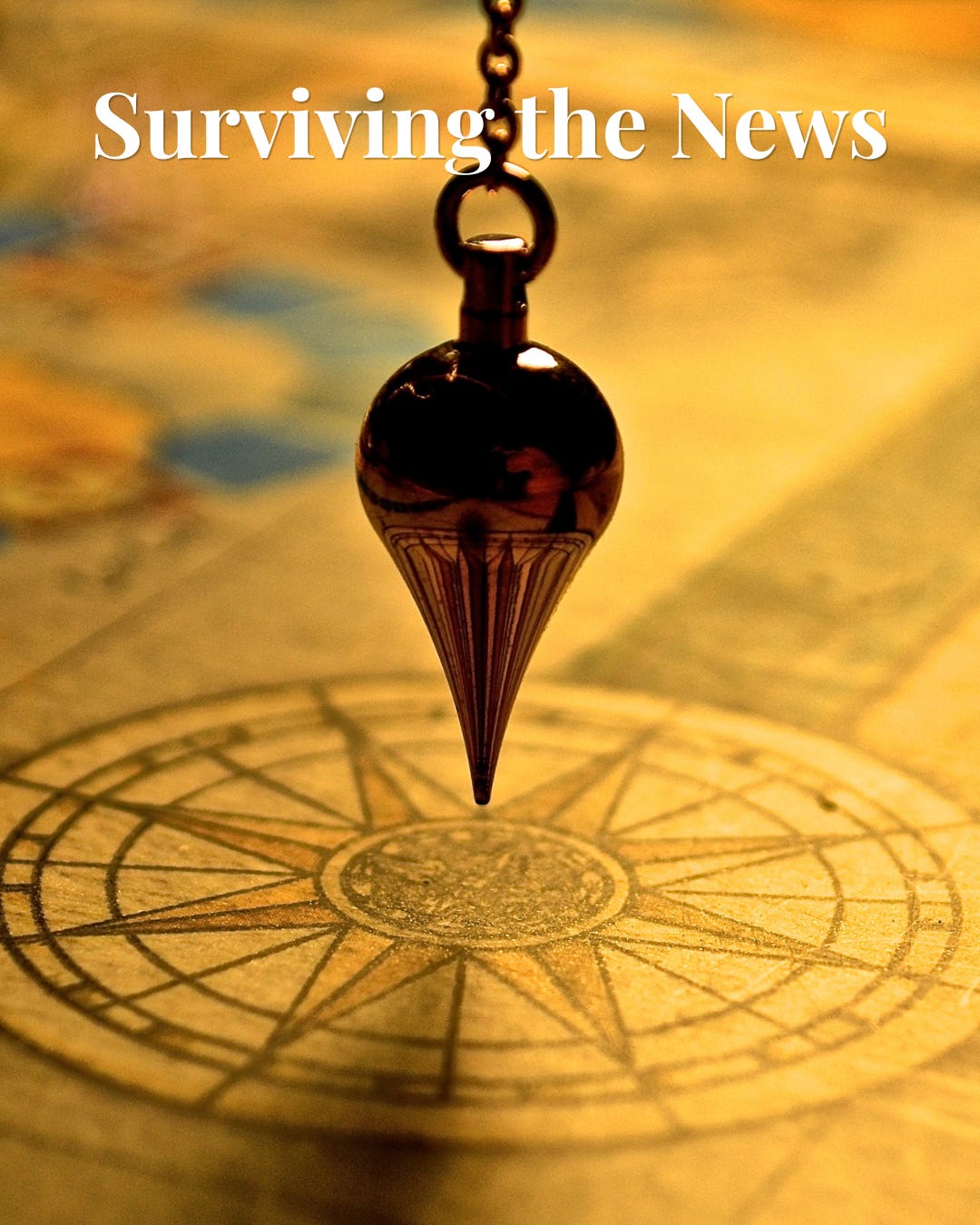
Vadim Zeland is a Russian physicist and mystic whose book Reality Transurfing offers one of the most useful models I have encountered for understanding how collective energy works. He calls it the pendulum.
A pendulum, in Zeland’s framework, is any structure created when a large group of people begin to think and feel in the same direction. Political parties are pendulums. Media networks are pendulums. Movements, ideologies, outrage cycles. When enough people radiate thought energy at the same frequency, that energy consolidates into something that begins to operate with its own momentum. Its own appetite.
And here is what makes the model so uncomfortable: the pendulum does not care whether you support it or oppose it. It feeds on both. It does not distinguish between the devoted follower and the furious critic. It only needs you to stay tuned in. Going back to The Betty Book, the “Invisibles” taught that “attention is existence.”
Think about that for a moment.
The person who watches the news out of duty and the person who watches out of dread are both supplying energy to the same structure. The person posting in outrage and the person hate-reading in silence are both locked at the same frequency. Zeland is precise about this: it does not matter which side you rock the pendulum from.
This is what I see in my office. Not people who are unintelligent. Not people who lack self-awareness. People who are genuinely compassionate, genuinely concerned about the state of the world, and who have been captured. Their thought energy has been attuned to a frequency that is not their own, it is pointed to whatever “-ism” is being broadcasted at the moment. And it is both destructive and draining.
In my last essay I wrote about a concept from the work of Stewart and Elizabeth White called the vortex. Betty described it as a spiral that forms when you fixate on a problem, contemplating its details until the problem itself begins to hold you in place. Zeland is describing the same mechanism. The pendulum captures your attention, and that attention generates its own momentum. Betty was talking about it at the individual level. Zeland is talking about it at the collective level. But the mechanics are identical. You lock onto something, feed it with your focus, and it grows. Most people have no idea they are doing it.
Zeland describes it this way. When you absorb information about disaster and misfortune, when you discuss it, when you feel it, you do not simply become informed. You shift. You move closer to the lifelines where those disasters are not just news stories you witness from a distance but realities you begin to inhabit. The stronger your emotional reaction, the more powerful the shift. The more you fixate on what you do not want, the more reliably it appears.
This is not magical thinking. This is something I watch happen in real time with real people, and I would bet you have too. The person who cannot stop reading about economic collapse and then makes fear-based financial decisions. The friend who is so consumed by political despair that they withdraw from every relationship that doesn’t share their exact frequency. The partner who used to laugh and now only warns or complains daily. It is exhausting.
They are not staying informed. They are being consumed.
So what do you do?
You do not fight the pendulum. Zeland is clear about this, and twenty years of clinical work confirms it. Resistance feeds the thing you are resisting. You do not argue your way out. You do not build walls. You do not perform a dramatic digital detox and announce it on social media, which you have no doubt seen. Usually, people that are most unhappy are the ones sharing their discontent on social media, to which I say keep an eye on them if they are your friend.
You have the ability to change the frequency. Or more precisely, you change the altitude.
The Invisibles, speaking through Betty White, made a distinction I think about often. They corrected a single word in transcription. Not attitude. Altitude. Attitude is horizontal. It is your position, your opinion, the side you have chosen. Altitude is vertical. It is the level of consciousness from which you observe. The pendulum wants your attitude. It does not care which one. What it cannot reach is your altitude.
This sounds abstract until you realize you already know how to do it. You have always known. It is what happens when you put the phone down and walk outside and feel the air on your face and remember, for a moment, that your actual life is still here. Waiting for you. Unharmed.
Zeland uses the metaphor of a radio. If you wake up every day tuned to a station you hate, you do not have to smash the radio. You do not have to write letters to the station manager. You change the station. You put your attention somewhere else. Not because you are in denial. Because you are choosing where your energy goes.
The practice is not complicated. The practice is deciding, every single day, that your energy belongs to you. That your attention is not a public utility. That the first thing you do in the morning does not have to be handing your nervous system over to people who profit from your fear.
I tell my clients something simple. Before you open your phone, ask yourself one question: am I about to be informed, or am I about to be consumed? If you are honest with yourself, you will know the difference. The body always knows. Informed feels like clarity. Consumed feels like a tightening in the chest, a quickening of the breath, a low hum of dread that follows you through the rest of the day and tumbling down another rabbit hole.
You can care about the world without sacrificing yourself to the machine that narrates it. And here is something even harder to sit with: everyone in this story serves a purpose. The politicians you cannot stand, or even hate. The pundits who make your blood pressure rise. The neighbor with the yard sign that makes you want to scream. They are all part of the pendulum, yes. But they are also all playing a role. You do not have to like them. You do not have to agree with them. But the moment you decide they are the enemy, you have handed your frequency and energy over. Judgment is the lock. Not discernment. Discernment sees clearly and chooses where to place its attention. Judgment locks in and feeds.
You can be a thoughtful, engaged, morally serious person and still refuse to let the pendulum set the frequency of your inner life.
And you can love someone without following them into the place where the news has taken them. Sometimes the most compassionate thing you can do is stay on your own lifeline and leave the light on.
I am not asking you to stop caring. I am asking you to notice what caring has cost you. And I am asking you to consider the possibility that the version of you that is the most useful to the world, the most present to the people who love you, the most capable of actually doing something meaningful, is the version that has reclaimed the right to choose where their attention goes.
The pendulum will keep swinging whether you watch or not.
Your life, on the other hand, needs you here.